
- Blog
- Corporate News
- Product news
- Industry News

A Guide to Materials for Custom Insulated Bags

Introduction:
The performance of a cooler bag is only as good as the materials used in its construction. For sourcing managers, understanding the nuances of fabrics and linings is essential for creating a product that meets customer expectations. As a leading cooler bag manufacturer with 21 years of experience, Obaili offers a curated selection of materials designed for durability and thermal efficiency. The right material mix can elevate a simple bag into a premium outdoor accessory.
Outer Shell: Durability Meets Aesthetics
Most custom insulated bags use 600D Polyester or Oxford fabric for the exterior. These materials are chosen for their abrasion resistance and ability to hold vibrant dyes and logos. For premium outdoor brands, we also offer high-density TPU or heavy-duty tarpaulin, which provides a 'rugged' look and enhanced water resistance. To ensure long-term color vibrancy, all our fabrics are tested in our UV Laboratory, simulating months of sun exposure to prevent fading. We also specialize in Global Recycled Standard (GRS) certified materials, allowing brands to transition to sustainable shells without compromising on the professional look and feel.
Insulation: The Core of Performance
The middle layer is typically EPE (Expanded Polyethylene) foam. The thickness of this foam directly correlates to how long the bag will keep items cold. We provide options ranging from 5mm for lightweight lunch bags to 15mm or more for professional-grade delivery and camping coolers. For clients needing extreme performance, we also offer NBR (Nitrile Butadiene Rubber) foam, which provides superior thermal retention and a softer, more premium feel. Every material configuration is validated in our Thermostatic Lab, where we simulate 35℃ environments to guarantee ice retention performance.
Lining: Hygiene and Leakproofing
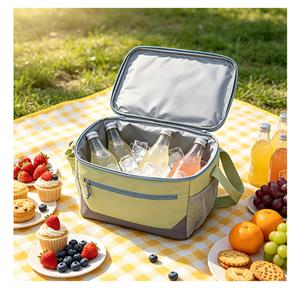
The inner lining is where many manufacturers cut corners, but not Obaili. We use food-grade PEVA or heat-sealed PVC. For high-end projects, TPU heat-sealing technology and High-Frequency (HF) welding ensure a 100% leakproof interior, preventing melted ice from seeping through the seams. This is a critical feature for 'soft coolers' used in boating or hiking. A high-quality liner is also easier to clean, which is a major selling point for hygiene-conscious consumers.
Expert Insight: The Importance of Component Matching
It's not just about the main fabrics; the hardware matters too. We recommend matching high-end fabrics with waterproof zippers—which we test for 5,000 cycles—and reinforced hardware to ensure the entire assembly is balanced. Using a cheap zipper on a high-spec TPU bag is a recipe for customer dissatisfaction. Our team helps you audit your Bill of Materials (BOM) to ensure that every component is fit for purpose and matches your target market's expectations.
Conclusion: Quality You Can Feel. Selecting the right materials is a collaborative process. Our team at Obaili helps you balance cost, performance, and weight to create the perfect bag, backed by 21 years of material science expertise.